Saturday, May 23, 2026

Simple fermented buckwheat crackers

I make these (mostly) 1-ingredient crackers and often get asked for the recipe, so here it is. They are crunchy, crispy, and gluten free. 

It takes 3 days, but involves only 1 simple 5-minute step each day. 

Disclaimer: I have never successfully made these crackers outside of my own kitchen, so your results may vary. I think the issue is the oven temperature. More on that below. 

You will need whole buckwheat groats, raw, not toasted. I order them from nuts.com 

https://share.nuts.com/Jennnifer

Day 1: Soak. In a bowl, cover 2 cups buckwheat groats with water (cover with water about an inch over the top since they will swell). Leave to soak 24 hours. 

Day 2: Blend. Do not rinse, but pour your soaked groats into a blender and blend to a batter consistency. Let ferment 24 hours on the counter (can do more, can do less, more time adds more flavor). 

Day 3: Preheat oven, pour, and bake

We did change ovens, and while my batches almost always worked in the old oven, they came out crumbly and terrible in the new oven. I think the old oven had wildly different temperatures throughout, and was much hotter on the bottom. To mimic this environment in my new, more even-temperature oven, I use 2 pizza stones, one on each shelf, to hold the heat and I preheat the oven really hot, to 450 degrees, and let the stones really heat up (maybe 20 minutes).

Add a teaspoon of salt to the batter, stir, then pour the batter out onto cookie sheets. 

Sprinkle any toppings you’d like on the batter. My favorite is sesame seeds, sunflower seeds, and pumpkin seeds.


Cook (on preheated pizza stones or in an oven with a hot bottom) at a really low temperature for a long time. Currently I use 230 degrees for 3 hours. The old oven (from last millennium) was more like 200 degrees for 4 hours. I’m afraid you’re going to have to figure this one out. 

My crackers curl up on the sides and tend not to stick to the cookie sheet if the temperature works out okay. They are crisp and coherent and stay together. (If yours are crumbles, they do make nice GF bread crumbs.…)

That’s it! I’m not sure why it works, but it works. I’d be interested to learn if it works for you. 

Saturday, July 06, 2024

The Kit

I’ve always loved the idea of cataloging what is in a person’s purse. The necessities, the surprises… I love that there are people who bring those “just in case” things. It makes our civilization better.

Who doesn’t love a kit with “everything you need to…”?

I no longer carry a purse, just my phone with my drivers license and a couple of credit cards in the case. On my person, I need one pocket for my phone one pocket for my glasses… But if I have a computer bag or a back pack, I carry this mini purse with my current go-to kit. It contains everything I need to happily survive for 24 to 48 hours. I’m documenting it so that if I lose it, I can recreate it more easily. It might also serve as inspiration for others. 🤓

One rule of the kit is that everything has to be able to pass through a TSA screening, so no liquids, gels, or sharp items. As much as I would love to include moisturizer or a pocket knife in “the kit,” it is against this rule.

Picture of the pouch used for "the kit"


The pouch itself was a handmade gift from my mom, is about the size of a paperback novel, and has three zipper compartments of graduated sizes. For me, the purpose of each pocket, from largest to smallest, has evolved to be:

  • Eating
  • Hygiene
  • Technology


Eating

The largest, top pocket contains

  • Salt in a tiny soy sauce bottle
  • Miniature Tajín salt-lime-chili mix
  • Tiny four-sided spice dispenser with curry, paprika, salt, and ground pepper. Boiled eggs will never be dull!
  • Knife, fork, and spoon. I originally had a really sweet, matching, set of metal utensils, but one by one they got taken away by various airline security checks. The knife was the smallest, roundest knife you can imagine, with tiny little teeth. It was the metal teeth, I was told, that were the no no. The fork survived the TSA, but not the local small aircraft in Costa Rica. Some plastic utensils have broken over the years. What has survived is the current mishmash of items: a bamboo serrated knife and a plastic fork and spoon saved from some take-out items.
  • Foldable cup
  • Reusable, washable coffee filter because you never know when you are going to need one and it is such a simple thing, and yet frustrating when you have to do without.

Hygiene

This middle pocket contains

  • Tweezers
  • Folding nail clippers, so far TSA approved
  • Ear plugs
  • Q-tips
  • Dental floss—can also be used as string or thread for repairs. Floss cutter on the top can be useful for cutting threads without scissors. Oh how much I would love to be able to add a pocket knife!
  • Rubber flossers—can double as cleaners for charging ports, etc.
  • Dry toothpaste tablets to comply with no liquids and gels rule.
  • Foldable toothbrush where the handle serves as its own cover/case.
  • A small credit-card sized comb—this one has proven to be very durable!
  • Hair ties

Technology

The smallest, bottom pocket contains

  • 5v USB plug adapter
  • Lightning USB cable, 6ft
  • Headphones with mini audio jack and audio jack to lightning adaptor
  • Cleaning cloth
  • USB pen drive
  • Stylus

It is amazing how much will usefully fit in this small pouch.

What items would you add or leave off?


Check this out: a better low-tech faucet design

Automatic faucets in public restrooms (and more and more in our homes as well), the kind that “sense” your hands are okay. Actually, kind of “meh.” They often don’t work that great and they require a source of power.

However, I do love being able to get my hands wet, turn off the water, soap up, wash, then turn on the water to rinse, all without touching the faucet. That is the ideal.

And now I have been seeing more and more of these long-handled faucets in public restrooms. You can use your wrist to easily turn the faucet on and off mechanically, no high-tech “sensing” necessary! Simple and functional, I am a fan.


I hope to see more of these around in future. 


Friday, July 05, 2024

Ventilation

(an unfinished sketch)

According to José-Luis Jimenez, it has been clear since the start of the COVID 19 pandemic—since the March 10, 2020, Skagit Valley choir incident [1]—that this disease is spread by aerosols, or small airborne particles. It is not so much spread by larger droplets, or touch, or contact with surfaces that have been touched. It is spread by air.

The Skagit Valley Choral knew there was COVID (as yet unnamed, but known to be a novel respiratory virus) in the community, so they set up their rehearsal very carefully and thoughtfully in a gymnasium with social distancing. It was documented where everyone was positioned, for how long, and in what size of room. They were singing, so everyone was exhaling large amounts of air into the room. After the rehearsal, 53 of the 61 people attending got sick with COVID 19 symptoms and 2 people died. Tragic.

Since the amount of time, volume of the room, and location of individuals was known, they could model how the virus spread. According to Jimenez, the easiest fit was airborne transmission.

It has taken the public health community a long time to come around to this view. Plexiglass screens were put up and social distancing was recommended to protect from droplets. Surfaces were sanitized to protect from touch. Masking—a way to filter the air—was late to come in to the recommendations. At first, good masks were not available. By the time effective masks were widely available, many mask mandates were coming to an end.

Ventilation has never been highlighted by the public health authorities as a key factor in the spread of COVID 19, even though it is known to be a key factor in airborne transmission and appears to be the primary method of COVID 19 spread. The resistance to embracing the evidence that COVID 19 is transmitted via the air has a long history. After the germ theory of disease transmission came to the forefront, public health officials worked hard to downplay the previous belief that disease was spread by ‘bad air.’ For example, the disease ‘malaria’ was thought to be spread by bad air. Instead, with knowledge of germ transmission, public health messaging promoted washing hands and covering your cough, but not ‘good air.’ This ‘anti-air’ focus persisted into the 2020s.

As Jimenez says, to protect yourself against transmission of aerosol-borne disease, first, protect yourself with ventilation. If ventilation is not an option, use filtration such as MERV-13 filters or N95 masks.

This is a simple protocol to follow but very different from social distancing, washing your hands, or covering your cough.

The ventilation of a space with people in it can be assessed relatively simply by measuring carbon dioxide (CO2) levels. People exhale CO2, so the amount of CO2 in a space is a proxy for how much of the air you are breathing in was expelled by other humans. If it is your own expelled air, there is little concern, but if the expelled air comes from a large number of other people, and this air is not filtered by masks or air filters, then your risk of inhaling and contracting COVID 19 increases.

Baseline CO2 levels from outside air are about 420 parts per million (ppm). A high CO2 level in a space means there is more exhaled air than fresh air.

Some countries, such as Sweden and South Korea, have long seen clean air, or good ventilation, as a health priority. Those countries have fared relatively well in the pandemic. Some countries, like South Korea and Japan have CO2 monitors posted in restaurants and movie theaters. Patrons can see at a glance how good the ventilation is.

One interesting piece of history I recently learned was about the required French lunch break. In France, you are required to leave the building and go out and have lunch. You are not allowed to eat lunch at your desk. Usually this is seen as part of the French culture of a hot lunch as a sort of human right. If you do not have a leisurely, sit-down, hot lunch, you are somewhat uncivilized. Bag lunches, or “brown bags” are not much tolerated.

It turns out that the reason a lunch break is required is not because of some cultural culinary tradition, but because of ventilation! It was so that factory workers would leave the building and it could be aired out. The French lunch break was for health.

Clean air and health are still very much connected and ventilation in buildings in the US is highly variable. Some children attend schools with good ventilation while others do not.

Good ventilation is something worth paying attention to and worth fighting for.

[1] Miller SL, Nazaroff WW, Jimenez JL, Boerstra A, Buonanno G, Dancer SJ, et al. (March 2021). "Transmission of SARS-CoV-2 by inhalation of respiratory aerosol in the Skagit Valley Chorale superspreading event"Indoor Air31 (2): 314–323. Bibcode:2021InAir..31..314Mdoi:10.1111/ina.12751PMC 7537089PMID 32979298.


Thursday, July 04, 2024

Atmosphere

(an unfinished sketch)


I am listening to an interview about the evolution of animal sound with David George Haskell who wrote the book Sounds Wild and Broken: sonic marvels, evolution’s creativity, and the crisis of sensory extinction.

“For hundreds of millions of years, nature was silent. No birds chirping, no insects buzzing. But then, things changed.”

For sound to be meaningful, Haskell says, something has to first be listening. So making sound is not enough, it needs to be heard.

And then I got to thinking about why we have sound in the first place, and a lot of it has to do with the density of particles in the atmosphere. In space, where particles are sparse, there is no sound because there is too much nothingness to vibrate.

The reason we have an atmosphere is because we have a magnetosphere—and the reason we have a magnetosphere is because there is a molten core in the Earth that, when spinning, creates a positive and negative charge that makes a magnetic orb around our planet. The magnetosphere protects the atmosphere from being blown away by the solar wind.

Mars no longer has a molten core and doesn't really have a magnetosphere. It has an atmosphere, but not very much of one. One theory is that after Mars lost its magnetosphere, due to having a solid core, the atmosphere is slowly getting blown away, lost, by the solar wind and solar storms. It is more difficult to hear sounds on Mars (though we have recently heard recording sent back to Earth from Mars rovers).

I also learned that Mercury has a magnetosphere (molten, spinning core), but no atmosphere… So we have examples of atmosphere, no magnetosphere (Mars), magnetosphere, no atmosphere (Mercury), and magnetosphere with thick atmosphere (Earth).

So on Earth, there were all these dense particles that allowed sounds to be transmitted, and so hearing evolved. Hearing could be useful to avoid predators or to find prey, for example. But when did hearing become a social thing? I can’t remember all the details David George Haskell outlines (read the book to find out!), but I remember him saying that animals that could move far, quickly, like frogs or birds, were more able to use sound because they could move before predators could use the sound to locate them. Perhaps that is why frog song and bird song and insect songs are so varied and complex.

Evolving inside of an atmosphere not only lets sounds be heard, but also filters out much of the electromagnetic energy released from the Sun—the solar spectrum. Again this filtering is protective for us. There is a huge range of “possible” spectra, but much of it, like radiation, is deadly to us. 

It is not a coincidence that the small part of the spectrum that we humans call “visible light”, the part that we perceive as a rainbow of colors, accounts for the bulk of the spectrum allowed to filter through the atmosphere. The part of the spectrum that we have evolved in, the part created by our atmosphere, is the part that we see.

And this evolution thing is amazing. It is because of our magnetosphere and atmosphere that life probably evolved in the first place. It is because of our atmosphere that we can hear sounds and see the colors that we see. From this has come bird songs and symphonies and paintings. The atmosphere bathes our senses.

Saturday, January 19, 2019

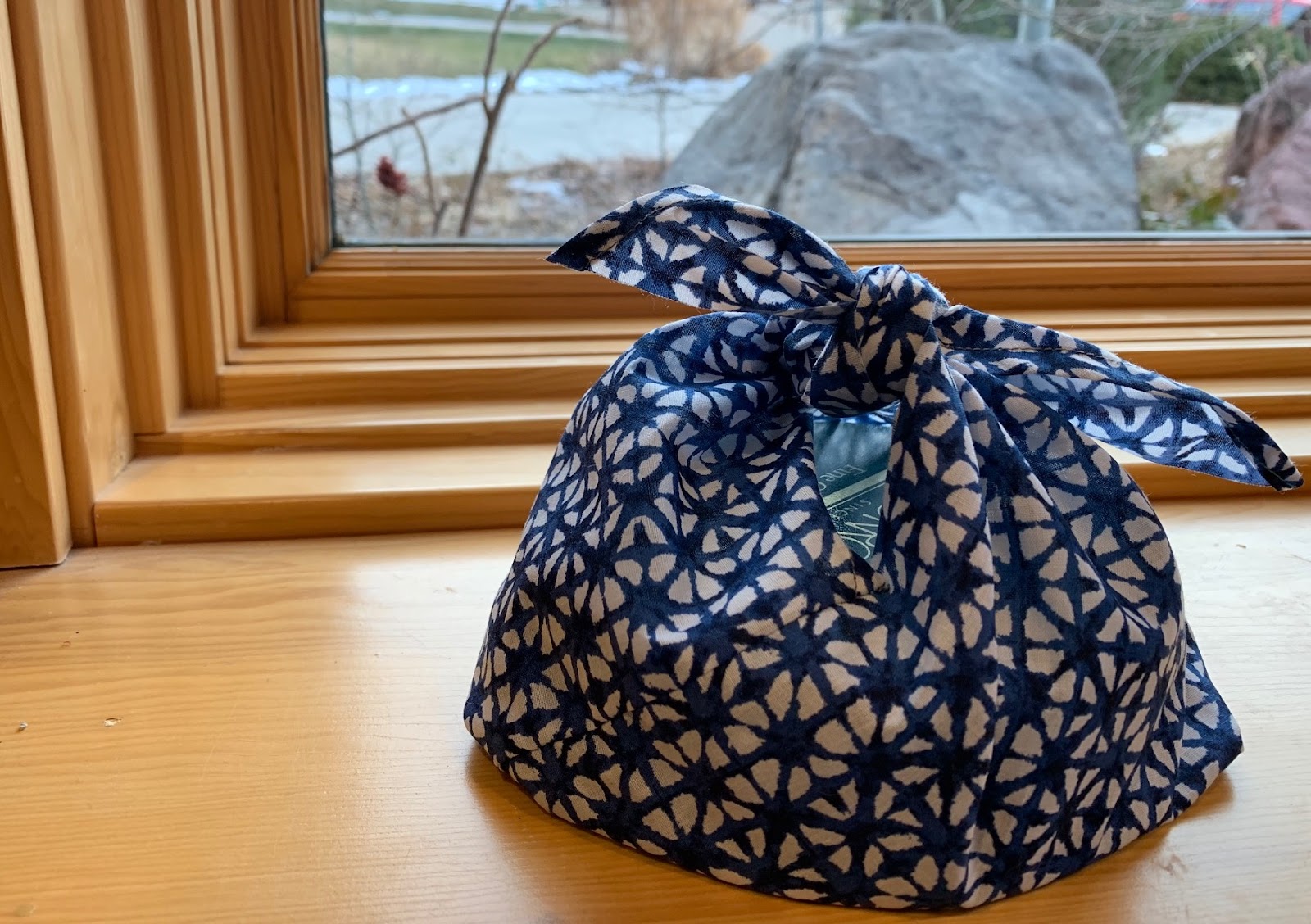
How to: sew a bento bag


Every year I like to make something quick and fun for friends. Last year, it was bento bags—little furoshiki tie bags that can carry a bento box, a sandwich, or a tupperware or pyrex container with your lunch. They also make good produce bags. And a knitting friend uses hers to carry her yarn around her wrist while she knits.

Friday, December 18, 2015

How to wrap

Last year’s wrapping went so well, I wanted to share.


Maybe you enjoy wrapping. Maybe you enjoy a little bit of wrapping? Great. But if it becomes a chore, here is a foolproof method that, for me, makes even a large amount of wrapping sort of enjoyable. The key is to automate the process,

Wednesday, March 18, 2015

Reheating without the microwave


One of my favorite uses of the microwave is to reheat food. Since it works by heating up the water molecules, it doesn't seem to dry out the food. Also, you can heat it up right in your bowl/plate. And, since your plate/bowl can then go right in the dishwasher, it is one less plate/bowl to wash. And it is fast.

Heating leftovers up on the stove usually requires washing a pot and eating out of a different dish.  Which, lets face it, is a pain.

Until now.

While I don't know that microwaves are an unmitigated evil, I have been reading about how

Monday, January 12, 2015

The omnipresent (yet ellusive) Silver Fern of New Zealand

The silver fern has become the iconic symbol of New Zealand. Here are a variety of representations I found at the Aukland airport alone:


I love it's graphic black-and-white abstraction, the use of positive and negative space, and how the design melds well with

Sunday, July 20, 2014

Yellowstone


We are not planners so that is one reason we got the van. No need for reservations or tickets. We did block out a week for a family vacation (I had “go somewhere” in the calendar) and we looked to Yellowstone as a destination. It’s about a 9-hour drive from Boulder. You might want to plan your trip, but your itinerary could go something like this:

Thursday, September 20, 2012

How to: DIY disposable cloth napkins

Have to share this idea.


The other day I went to my happy place, Anthropologie, and in the sale section they had a sort of cloth napkin that was disposable and that you could tear off a roll. Not with snaps or anything, just a roll of cheap cotton fabric in cute gingham prints that you could tear. Kind of like an upscale picnic item. I was intrigued but I didn't bite. But at home, I did have, waiting for me to do something with them, two worn out pillow cases.

You know when sheets or pillow cases get so thin there is no point in mending them? A sheet might become a tarp for spray painting or a pillow case might become rags for cleaning. Once I made waxing strips out of an old sheet and and old pillow case. But we currently have enough rags and tarps and waxing strips so these pillow cases were just waiting. I couldn't throw them away, but I didn't have much time to deal with them either.

Soooo...idea! I quickly tore each pillow case

Genius

Kadin was working on a math problem for his homework and asked for my help. He actually didn't bring the problem home but said he remembered it. He tried to explain it to me and it was something like this:
A jail has 100 cells. The guard comes in the first day and unlocks all the cells. On the second day he locks all the cells that are multiples of two. On the third day he unlocks all the cells that are multiples of 3 (or something like that, Kadin wasn't exactly sure) and so on. The question was, on the 100th day, which cells would be unlocked?

So we agreed there must be a pattern. Kadin had gone through and figured out

Friday, December 24, 2010

Final grand theory (France’s gift to me)

What did I learn in France? The big take-away for me was the relative lack of shame. And I am surprised by how revolutionary this is to me. All the functionality and sense of entitlement shown by the French could very well come from what I see as a lack of desire to make people feel bad. Or, put another way, a great desire to shore people up, let them feel good, appreciate them for who they are, and protect them from humiliation.

And it could all be in my head—is probably a theory that says more about me than anything about “the French”—but I am enjoying the fantasy and finding it really helpful. (I chose not to watch French daytime TV just to keep it alive.)

In the US, and even more so in England (and perhaps in other northern European countries like Germany and Scandinavia), I find there is a

Thursday, December 23, 2010

Words that suddenly sound weird

For examples of my habitual train of thought about language and how my brain is slowly able to put the pieces together, over a couple of days, I kept track of words that stood out for me.

At a café, a sign saying service is only at the “comptoir.” Comptoir, a word I associated with banks and accounting. A compte is an account. So why at a restaurant? And then, of course, the “counter.” Same deal: account, counter. Just the same in English. Only it doesn’t sound weird to me at all in English because

Wednesday, December 22, 2010

Big fat black pen revisited

I had one more trip back to the Mairie to pay Kadin’s school lunch bill. I had recently received the bill for September and October, but needed to pay for November and December as well. They would normally bill me for this in March, but

Monday, December 20, 2010

Two classes

Had my last French class on Thursday and my last yoga class on Friday. These 5.5 hours of classes each week were my biggest chance at speaking French. Invaluable because French was the only common language and we were forced to use it. Awkward/comical as it was at times, there was communication going on!

First I have to quickly tell about the back-to-school night for Kadin’s French-as-a-Second-Language class to illustrate how hard it can be to find a situation where you are really forced to speak French. The teacher introduced herself and said she wanted to start by going around and having the parents introduce themselves. We should say our name, where we were from, and who our student was.

I had just re-learned all this introduction stuff in my French class, so I was excited to say “My name is Jenny, I am from the United States,” etc. in French. But the first couple to go asked if they could speak English, they were from Ethiopia. The next couple also spoke English, they were from India. Then the next couple was from Korea, they also spoke English. So did the woman from Poland and the family from Malta etc. etc.

Wow, a veritable United Nations and what is the common language? English. By the time they got to me, I just went ahead and spoke English too.

But this was not the case in my French class. While a few of the students spoke English, most did not. I was the only American and by far the oldest person. The others were mostly Chinese women in their late teens or early 20s, the one male was a young engineering student from Brazil, and the class was rounded out by a Lithuanian woman doing post doctoral research in Grenoble.

When we introduced ourselves, we found out the Chinese women were all only children. I told the Chinese students that I had been to China when I was 10, in 1976. They looked a little shocked and replied, “You were? Well, I wasn’t.” They hadn’t been born yet and there has been so much change in the intervening decades, it was probably ancient history to them.

The Lithuanian woman seemed the closest to my age, so when we were learning the past tense, she was saying “I was born in 19…” and this is a good phrase because you would use être instead of avoir to form the past tense with the verb “to be born,” and then she hesitated, so I chimed in with “soixsante” the start of 60 and 70, thinking that would give her a good 2-decade range in which to be born, but no. She was born in 1980. So that was the person closest to my age. She was 6 when I last took a French class!

And so it went. I was definitely the most willing to make a fool of myself in the class. Also perhaps the one who knew the least French, but I was glad to be a little beyond my ability since I was only here 4 months. I needed to step on the accelerator!

In one class we were learning the different ways to describe periods of time using words like “since” or “during.” We were supposed to answer questions like, “How long have you lived on your own?” “How long have you been drinking alcohol?” “When did you start driving?” “How long have you been voting?” “How long have you been married?” I actually got to answer these questions with the years, as was the plan, but almost everyone else had to reply, “I have never….” Finally, some age and experience pays off!

I loved the class and I will miss it. It often gave me a headache, but my old and ossified brain has stretched a tiny bit.

Yoga class was also an ideal French immersion experience. Iyengar is a topic I know well and the teacher spoke clearly and slowly all about the parts of the body and where to put them. This was great.

The first class, I wasn’t sure what a cerveau was, I thought maybe it was a deer? So I just channeled my inner deer and imagined antlers growing out of my head while lying on the floor. And I learned the word for floor, sol, which is a perfect homophone for a different English word, and the word for ceiling, plafond, which is quite a nice sounding word that you can easily admire.

In this class, I was the youngest. Once again, nobody spoke much English. Each week I would try to carry on a simple conversation with the teacher about Iyengar in France or if she had been to India. Others in the class would engage me briefly before or after and were very kind and patient with my French. I even managed to make a few jokes during class that people seemed to understand.

The biggest difficulty came in Eagle pose when we were supposed to put one arm au dessus and the other arm au dessous and one leg au dessus and the other leg au dessous. Still can’t distinguish between those antonyms and it’s so easy to get tangled up!

I am sad that class has ended too. My body really liked it and my cerveau did too.

Saturday, December 18, 2010

The stale end of the day

This phrase from Greg’s sci-fi novel “the stale end of the day” sticks with me all the time. French bread is really only good for one day. You have a stale end, everyday.

(I am also not a night person, so the end of the day often does feel stale to me as well.)

And things here are fresh, used quickly and discarded when old. Everything is smaller: toilet paper, portions, refrigerators. They are always ready for change.

Yet waste is reviled. The pigeons thrive on this. They are part of the whole ecosystem. People reuse and recycle. Pigeons pick up the pieces.

It makes me think the USA has a proportion problem----maybe because it was largely settled by people who had big dreams, who were not satisfied elsewhere, so left?

And that brings to mind my morning in Paris at the Puces or the flea markets. These are amazing places that have created something from nothing.

According to the brochure I read, the “rag and bone men” were kicked out of the city proper (in like 1870) and so made their living at the margins. Every Sunday they would lay out their wares on the ground for sale. By 1920, there were more organized collections of market stalls at the gates around the city. The gypsies and their manouche jazz became associated with this flea market tradition. So where once there were outcasts, there was now music and food and things for sale. Crowds would gather.

And the markets kept evolving so that today at the center you can find a lovely mixture of pseudo established stalls/stores selling vintage clothing and antiques, second hand furniture and industrial signs, buttons and jewelry, books and prints, and pretty much any kind of bric-a-brac you can imagine. Prices in these well-established stalls seemed high to me, but it was like eye candy to look.

I loved how each stall had its own style and its own specialty. It was all sort of ad hoc and organic with winding alleys where it was easy to get disoriented and turned around. I had been warned not to carry much money as this was also a haven for pickpockets (another part of the ecosystem that thrives on crowds).

The stall keepers all know each other and have their own thriving community. At lunchtime, a neighbor or family member brings a hot lunch, and they lay it out on their antique tables and dine. They seemed incredibly gracious with customers and loved to gab and chat.

One common technique is to take something that would normally be discarded, an old key for example, collect lots of these together, organize them, display them in an interesting way, and then sell them for a couple of euros each. Trash to treasure, just like that. It was beautiful.

Then, around these now-established market stalls, there are other less permanent stalls selling wares from Africa and Asia and usually run by more recent immigrants, and then, on the edges of those stalls, are streets where men just put a blanket on the ground at their feet and sell whatever they can find to sell. It is the same old tradition.

On the fringes there were even the proverbial guys selling watches from the inside of their trench coats. Okay, so maybe not watches and maybe not a trench coat, but more like something they had just lifted from a store. It was seedy and fascinating and incredibly lively, especially on a Sunday morning when other shops are closed.

An aside: later in the day I went to the huge Galleries Lafayette department store in the center of Paris, thinking surely it, of all places, would be open. There were thousands of people there thronging around the building looking at the Christmas window displays, but it was closed. I have to wonder what kind of forces are at work to keep such a capitalist enterprise closed when thousands of people wanted a chance to get inside. Fascinating!

The rag and bone men don’t have that luxury. Their niche is at the edges before something becomes established. They fill in when the other shops are closed. They take what is discarded or underappreciated and turn it into art. Where some see a problem, they see an opportunity.

À Paris

I would like to thank all the service people who are on the front lines: all the clerks, waiters, and other professionals who have borne with my mangled French and helped me to improve it. Now that I know a little bit more, I see how tough your job is and how much further I need to go! Thank you for your courtesy and patience while I learn.

I did finally make a spontaneous, last minute trip to Paris for a day. It was great. I hunted beads and ate at a wonderful gluten-free restaurant.

I was struck by how much English there was all around me in Paris. There is much less in Grenoble. And also struck, surprisingly, by how polite and helpful the Parisiens were.

From my kind of in-between state, I can see how easily misunderstandings and resentments can develop.

Case #1: I’m in line at an urban grocery store buying a pear and some almonds. Behind me are two older American gentlemen buying a bottle of wine. They are clearly on vacation, talking about how good the bread is and what their wives are doing back at the hotel. They are well dressed and look like the golf-club type, relaxed and in tourist mode. In front of me is a local and a regular. She is buying a huge amount of groceries---probably her weekly Saturday morning shop. She is chatting with the clerk and the two guys who are packing her stuff in crates for free delivery (a common service in the city if you buy a huge amount). It is taking a while. But we are all waiting patiently.

After a few minutes, the clerk calls out to someone and then tells me to go to another line as it is about to open. It takes me a little while (as usual) to realize she is talking to me and to understand what her plan is. But it makes sense. There should be an express lane. So I go to the new line and wait for the new clerk.

The first clerk is now trying to get the attention of the men who were behind me. She is telling them to get into the new line. They have no idea she is talking to them. By about the fifth repetition, once she is yelling, they finally realize this woman is saying something to them.

From their point of view, the first they are aware of it, someone is yelling at them. They have no idea what she wants, just that she is yelling. So I tell them to come over to this line, it will be opening shortly.

“Huh? Why?”

I forget what the express lane is called in English, so say something about a “Rapid check out.” They shrug, and move over, a bit jarred, their peace and tranquility upset. They just want a bottle of wine to share with their wives, they don’t want to be yelled at and moved about. The clerk, for the life of her, can’t understand how anyone can be that dense.

Case #2: I’m in a small vendor’s stall at the puces, a conglomeration of antique vendors on the outskirts of the city. There is an American guy buying 8 of some small, funky French antique. He is happy with his find, but also seems slightly nervous, like he might be getting ripped off.

From my perspective, he does everything wrong. He doesn’t start with politeness, he is sarcastic, talks loudly, he is not good with the numbers thing as the numbers thing is always a problem, his French is minimal, his accent terrible. He’ll repeat the numbers the older female proprietor says and say, “Oh, you mean huit.” Acting like he is correcting her.

The saleswoman, meanwhile, is happy to make the sale, is being very polite, and is muttering to herself in French while she packages up his items, “oh, this is a pretty one, and [[crash!!]] don’t worry, it’s not serious, there are lots of things in this shop, things fall, it’s not a problem, I’ll just find a bag,” etc. etc. He understands none of this, is not sure what is going on.

So he tries some small talk. It is unusually cold out, so he chimes in with what he thinks is the old standard weather-related conversation starter: "C'est froid." Just like her, he gets no response. The correct construction is “Il fait froid.” What he said doesn’t make sense. It might sound to her like something about liver or faith, but not the temperature. So she ignores his odd non-sequitor.

Both are trying, but neither is being understood by the other. He is coming across as rude and she is coming across as shifty.

Overall, I came away extremely impressed by how the Parisians actually manage to be polite 99% of the time, given how exhausting it must be to constantly not be understood and to constantly hear your language mangled. I think they have the patience of Job.

And then I noticed the deferential/pseudo shy/apologetic demeanor of Americans trying to be polite---I do this all the time myself. At the gluten-free restaurant I could tell the nationality of who was coming in the door by whether they entered with confidence (French) or sort of apologetically: “I’m sorry, but do you have a table? You wouldn’t happen to have a table, would you?” That would be the Anglophone way. Seeing it with fresh eyes, I think it comes across as cloying. I could see how that too could get tiring.

And during my Sunday lunch at the restaurant, I witnessed an amazing thing. An American couple came in, in that sort of hesitant, American way. By this time, the restaurant was full. I felt bad for the couple because (1) it was freezing out and (2) this was the only gluten-free restaurant in Paris and if you need to be gluten free, it is very difficult to just eat anywhere.

The hostess kindly tells them it is full. They tip their heads to one side and look sort of distressed and pathetic. Full? Yes, full. Their eyes narrow, their mouths hang open with their bottom teeth showing. Then the two women next to me say they are just leaving. The Americans sort of bow and look down and thank them, awkwardly standing to the side as the women leave.

Soon a Canadian couple comes in. The hostess again informs them the restaurant is full. They sigh and leave.

Then, a French family walks in: a mother, father, and three young children. They too are told it is full. The mother, a very stylish, happy blond smiles and explains they have no other options as they need to eat gluten free. The hostess again repeats that they are full.

I’m not sure what all happened next and what the exchange was, but the mother never apologized, never complained, never whined, just held her ground, confidently smiled and made some suggestions and before I knew it, the furniture was being rearranged, a table was being rolled out, and the family of 5 was being seated. A real voila! moment. Everyone was smiling then.

Friday, December 17, 2010

Vive la différence!

In Germany, they capitalize almost everything
In France, almost nothing

In Switzerland, they eat outside at every opportunity
In France, anything but a leisurly hot lunch is considered barbaric

In England they wait in neat lines, expect you to defer to others, and are concerned about what others think
In france they are not shy about forming clumps, expect you to have a sense of entitlement, and could care less what others think

France has a dire overabundance of vowels while eastern Europe has an abject scarcity

Defined by difference

If you give it up, you cease to exist!

Mesa Messenger from afar


While reading the most recent online newsletter from Kadin’s elementary school in Boulder I was struck by how the principle chose to emphasize two programs: first, their “positive behavior support” program where students are rewarded for good behavior (instead of just being punished for bad behavior), and second, the focus on developing a student’s “voice” or personal style in their writing, something they will be evaluated on. Both of these things—the only two items on his agenda—are totally and utterly foreign to the system in France!

Teachers in the kid’s schools here seem to be on the lookout only for bad behavior. Kadin came home the other day and said his class was “bavarding” so much that the teacher threatened to call the police. Wow. And in the states, his teachers think raising their voice is going too far... From what I gather, yelling is pretty much the norm here. I too once thought yelling was inevitable until I saw more skilled classroom management in action. It's pretty amazing, and pretty effective.

And I went to a parent teacher conference at Rees’s school the other day. We were walking down a corridor mostly reserved for teachers. Rees was nervous, but I told him it was okay because he was with me. Then we got lost, couldn’t find the room, and walked down that corridor several more times. On about the third time through, for some reason, Rees—who must have been pretty bored at that point—got it into his head that it would be fun to slide on his back on his fleece hoodie on the polished floor. I asked him what he was doing and told him that the floor was dirty, it was where people put their feet (and we all know those feet were on the sidewalk and we also know what is on the sidewalk in abundance here in France…), but he didn’t seem to care about that, so I just ignored him (didn’t think it was so bad, just gross) and walked a few steps ahead, knowing the moment would pass (as soon as we hit the carpet).

Just then, a teacher came out into the corridor, saw Rees, and immediately marched over with a loud, accusing, “Ce qu'il se passe ici?!” In faltering French I reply something like, “C’est mon fils,” “That is my son.” And she accepted that and the matter was dropped. I got the feeling this “Ce qu'il se passe!” is the first order of business around here. Accusations first, explanations later. It's the kind of environment where everyone is focused on the bad and aberrant, where no one would be caught being good.

Still don’t know what inspired Rees’s strange behavior—there was a high, four-story sky-lit ceiling he could look up at when he was on his back—but he said I was like his armor. I did kind of sense he was pushing at the limits he felt all around him. Still, it was not my proudest moment to admit to that teacher he was my son! But we love him.

And in French school, it is hard to imagine a standard evaluation based on “voice” or personal expression. Ha! The criteria are much more structured and the value is placed on fitting in. Even using “I” in an essay is discouraged. And in handwriting too, there is no idea that everyone might develop a personal style. The emphasis instead is on one proper form to strive to achieve. And there is no acknowledgement of differences in learning style or ways of learning. It really is sink or swim (we won’t even talk about the swimming classes I've heard stories of where this is literally true…but at least the state funds swimming lessons for all…).

So I was overjoyed to learn that the child in Kadin’s class who is the “problem” kid, the one always being disciplined, was the one who excelled at the “cross” (inter-school track meet) and won the whole thing for his class. First place in the whole city for running. Gosh, could there be a connection???

Then Carina told me about an email thread/discussion she received via the parent organization at the elementary school. Apparently, in the German section of the school, a girl was assaulted by a teacher who lost her temper and pulled the girl’s hair. The parent (who I believe was German) asked the parent association what she could do. The advice from the other parents? Keep quiet because if she complains about the assault, the teacher could file a civil suit against her. The parent then asked what she could do to protect her child. The answer: not much.

Looks like another case of worker’s rights gone too far! Since I had heard this story third hand, I asked the head of the American School (Rees’s school) about it and she confirmed that this could well be the case. Unfortunately, there truly was a chance of the parent being sued by the teacher if the parent complained about the assault.

So we’re gaining some good perspective and won’t be taking the positive programs for discipline and creative expression in the Boulder schools for granted!