Heard last night on the radio:
When President Bush was asked about Roe vs. Wade, he replied:
"I don’t really care what you do. The important thing is to get out of New Orleans, one way or the other."
Monday, September 26, 2005

Tuesday, September 20, 2005
In praise of the fad and the short-lived
It occurred to me the other day that I tend to dismiss new exercise crazes as frivolous fads. It seems that every few months something new will come along and there will be neat new equipment to buy. There is yoga and “power yoga” and “hot yoga” and Pilates and NIA and the walking movement with pedometers and ski skates and skate skis and snowshoes and walking sticks and mountain bikes and road bikes and cruisers. Thrift stores are filled with old exercise bikes, Nordic tracks, elliptical trainers, and so on. I realized that I kind of look down my nose at all the equipment, roll my eyes, and see each new fad as short lived and a bit of a waste. I resist the change and am waiting for THE THING or fall back on the classic walking. I realized that if I was going to take up an exercise, something deep inside me wanted to feel a real commitment to it and to the equipment, for the LONG TERM. And I felt the less equipment, the better.
But then it hit me. Why? What was I thinking? Why be reluctant to adopt the new trends? So what if they are short lived fads? This is exercise we are talking about! If it is novel and fun and good for you, what is the worry? Why do I have to be so stoic and old fashioned and committed? If I buy an exercised DVD and only do it four or five times, so what? It still cost less than four or five classes and it was not wasted. Why not go out and try every new thing? If I do it for a while and then move on to something else-the next thing-so much the better! What is the harm? There is only gain.
My acupuncturist is a former tri-athlete and she reminds me how good it is to change the kind of exercise you do and not to stick with only one thing all the time. In new exercises you use new muscles and don’t overuse others. I realize that for years I have been trying to find “my thing” and been wanting to commit to something and there is really no reason to do this at all. It feels good to throw that out and just commit to exercise in general, do lots of different things, and even embrace new fads, if only for a short time. I don’t know what was wrong with me before! I now want to be more open minded and an early adopter of new exercise fads. It can only be fun and helpful. Let’s go!
And then there is the thing with toys. I realize that I have always tended to buy presents for the kids that were toys of the highest quality---even heirloom quality---made of nice, solid wood. And now I have a house FULL of nice toys. Why? Greg just got Rees this large but sort of cheap plastic castle for his birthday. At first I was kind of annoyed, as I had seen a nice, solid, wooden one at a thrift store, but resisted buying it because we had so many toys. If we were going to get a castle, why not get a nice one? I thought. But then I realized it would stay and likely be with us for the long term. It is great to have a fun-for-now but not forever sort of castle. It will eventually break and move on. Phew! That is okay! That is for the best!
And it is the same with holiday decorations. On the one hand it seems a terrible waste to buy a tree every year and then throw it away. And now they have those fake, carve-able pumpkins that you can carve and keep forever. It is truly sad when a jack-o-lantern decays and shrivels and dies, but it is also a great thing. It reminds me of change and the seasons and, best of all, I don’t have to keep it around until next year. It is gone, compost!
Certainly it is not good to just waste things, to buy things that pollute or can’t be recycled and throw them out, but I can surely loosen up a little. I have tended to go too far in the other direction of late. For toys, exercise, and seasonal decorations I am ready to embrace the new, the temporary, and the fad. It’s time for me to lighten up and have some fun!
But then it hit me. Why? What was I thinking? Why be reluctant to adopt the new trends? So what if they are short lived fads? This is exercise we are talking about! If it is novel and fun and good for you, what is the worry? Why do I have to be so stoic and old fashioned and committed? If I buy an exercised DVD and only do it four or five times, so what? It still cost less than four or five classes and it was not wasted. Why not go out and try every new thing? If I do it for a while and then move on to something else-the next thing-so much the better! What is the harm? There is only gain.
My acupuncturist is a former tri-athlete and she reminds me how good it is to change the kind of exercise you do and not to stick with only one thing all the time. In new exercises you use new muscles and don’t overuse others. I realize that for years I have been trying to find “my thing” and been wanting to commit to something and there is really no reason to do this at all. It feels good to throw that out and just commit to exercise in general, do lots of different things, and even embrace new fads, if only for a short time. I don’t know what was wrong with me before! I now want to be more open minded and an early adopter of new exercise fads. It can only be fun and helpful. Let’s go!
And then there is the thing with toys. I realize that I have always tended to buy presents for the kids that were toys of the highest quality---even heirloom quality---made of nice, solid wood. And now I have a house FULL of nice toys. Why? Greg just got Rees this large but sort of cheap plastic castle for his birthday. At first I was kind of annoyed, as I had seen a nice, solid, wooden one at a thrift store, but resisted buying it because we had so many toys. If we were going to get a castle, why not get a nice one? I thought. But then I realized it would stay and likely be with us for the long term. It is great to have a fun-for-now but not forever sort of castle. It will eventually break and move on. Phew! That is okay! That is for the best!
And it is the same with holiday decorations. On the one hand it seems a terrible waste to buy a tree every year and then throw it away. And now they have those fake, carve-able pumpkins that you can carve and keep forever. It is truly sad when a jack-o-lantern decays and shrivels and dies, but it is also a great thing. It reminds me of change and the seasons and, best of all, I don’t have to keep it around until next year. It is gone, compost!
Certainly it is not good to just waste things, to buy things that pollute or can’t be recycled and throw them out, but I can surely loosen up a little. I have tended to go too far in the other direction of late. For toys, exercise, and seasonal decorations I am ready to embrace the new, the temporary, and the fad. It’s time for me to lighten up and have some fun!
The answer
Yes, it is what I have been waiting for! They just appeared in the mail box the other day and they solve my dilemma. No more thoughts about cat-motif checks for me, because now, courtesy of the Boulder Valley Humane Society, I have cat return-address labels. Hooray!
Oh yeah, and as of about 15 minutes ago, I have been convinced to enter Rex in the cat show this weekend as well. AND I will be going to something called a Rexception, a banquet on Saturday night, and to top it all off, I am staying overnight at the hotel as well. I even tried to arrange to carpool with someone so I could really get some immersion in the culture, but no luck there. Don’t know what kind of weekend I have in store or what one should wear to a cat show banquet, but I’ll find out soon!
Oh yeah, and as of about 15 minutes ago, I have been convinced to enter Rex in the cat show this weekend as well. AND I will be going to something called a Rexception, a banquet on Saturday night, and to top it all off, I am staying overnight at the hotel as well. I even tried to arrange to carpool with someone so I could really get some immersion in the culture, but no luck there. Don’t know what kind of weekend I have in store or what one should wear to a cat show banquet, but I’ll find out soon!
Tuesday, September 13, 2005
Feng Shui
Oh boy do I miss those kitties. The kittens are currently at a friend’s house and we are temporarily in an apartment. We are in an apartment because the roof has come off our house. This has happened on purpose, however, and it is a good thing as we are adding on a couple of rooms. (Boy has Katrina really put that in perspective for me!) The house, though “light and airy” at present, has no walls or roof to speak of. Great views, but it is also noisy and dusty. Not a shelter for man or beast in any sense of the word.
We found a nice furnished hotel-like two-bedroom apartment on campus, and because Greg is a professor, it is a truly cheap option for the four (make that six) of us. The one drawback is that pets are not allowed. When we first arrived in Boulder, we stayed in university housing (before pets) and noticed that though pets were not allowed, there were many people who had them anyway. So we figured we’d be one of those tenants this time around. Only the place we are staying this time around is slightly different from our old apartment. It has the added bonus that it is more truly furnished and they clean it on Tuesdays and Fridays, change the sheets, make the beds, etc. Really nice that they do this, but a sure-fire way to let them know about the feline members of the family.
Wanting to make it all work, we arranged an elaborate plan for Greg to take the kittens to work on the cleaning days. I dealt with disguising their food and litter; he dealt with the cats. We became kitten smugglers. It felt wrong to me, so pre-meditated and effortful. Not a passive sort of, ”Oh, I’m sorry, cats aren’t allowed? I didn’t know,” or, “it didn’t occur to me that it would be a problem.” So how to work it? Other ideas included bribing the cleaning staff, who were surely underpaid, not to report us. But this seemed triply wrong to me: first the pets, then the bribe, and then asking someone to take the bribe. We never seriously considered that.
The cats are small and not destructive, but it still made me tense every time they would meow or even when they would sit prettily on the windowsill. I was out much of the first day they were here, but during the one hour I was in the apartment, a man knocked at one of the doors (we have two doors, confusing!). And since I didn’t immediately know which door he was at, he thought no one was home and came in to pick up the university-owned phone. Yikes! I quickly shooed him out and handed him the phone through the door. But what if I had been away? It was our first day and already we were almost busted!
The next day was a cleaning day so Greg took the cats to work. He really seemed to enjoy the subterfuge. He said he also enjoyed having them at work. But the real wake up call came when I mentioned to the boys that they should tone down talk of the kitties because technically, they weren’t allowed. This truly distressed Rees. If it was wrong, it was wrong, no gray area about it. I have to admit it distressed me too. We tried to reassure him, but he could not relax. And what good instincts for him to know that what was wrong was wrong. We should encourage that instinct, not dismiss it. Finally, he said, “Mom, you know the cats? In the apartment, they are bad feng shui.”
He hit the nail on the head. I often talk about feng shui as something that either makes you feel comfortable and secure, or something that doesn’t. For the kids that would mean that leaving your glass of milk near the edge of the table or absent-mindedly rocking the pitcher of juice back and forth would be “bad feng shui.” I include in this category being loud and fast in a restaurant or behaving erratically in front of people carrying trays of food or walking on crutches. The response from the kids that, “I wasn’t going to crash into them,” doesn’t cut it for me. It is still distressing, and so “bad feng shui.” At one point, Rees had taken to asking me if he was bad feng shui! Poor kids. I was afraid they were going to grow up with a very distorted view of feng shui.
And the cats, usually a source of good feng shui as they come up to you and purr or sit prettily looking out the window, ears alert, tails twitching, had suddenly become a source of stress and danger. I tried to rationalize it, but it was clear that neither Rees nor I was comfortable with the situation. I imagined dirty looks from our neighbors in the apartment, I avoided going to the housing office to ask questions, and was tense every time I passed someone in the halls or walked by that especially menacing door labeled “Resident Manager.” Uggh.
So I started asking around and found the family of one of Rees’ friends who were cat lovers, but miraculously did not have cats. They were willing to cat sit. They are responsible and loving and I trust them completely. Good feng shui there. We delivered the cats to them and the cats have adjusted well to their new circumstances. Still, it seems a long time to be away from the kitties---six weeks when we have only had them for three months. But they seem happy and the energy in our apartment has improved dramatically. I can smile at the people in the halls now and have even had nice conversations with the resident manager. Our neighbors suddenly look much more friendly. The feng shui has definitely improved.
We found a nice furnished hotel-like two-bedroom apartment on campus, and because Greg is a professor, it is a truly cheap option for the four (make that six) of us. The one drawback is that pets are not allowed. When we first arrived in Boulder, we stayed in university housing (before pets) and noticed that though pets were not allowed, there were many people who had them anyway. So we figured we’d be one of those tenants this time around. Only the place we are staying this time around is slightly different from our old apartment. It has the added bonus that it is more truly furnished and they clean it on Tuesdays and Fridays, change the sheets, make the beds, etc. Really nice that they do this, but a sure-fire way to let them know about the feline members of the family.
Wanting to make it all work, we arranged an elaborate plan for Greg to take the kittens to work on the cleaning days. I dealt with disguising their food and litter; he dealt with the cats. We became kitten smugglers. It felt wrong to me, so pre-meditated and effortful. Not a passive sort of, ”Oh, I’m sorry, cats aren’t allowed? I didn’t know,” or, “it didn’t occur to me that it would be a problem.” So how to work it? Other ideas included bribing the cleaning staff, who were surely underpaid, not to report us. But this seemed triply wrong to me: first the pets, then the bribe, and then asking someone to take the bribe. We never seriously considered that.
The cats are small and not destructive, but it still made me tense every time they would meow or even when they would sit prettily on the windowsill. I was out much of the first day they were here, but during the one hour I was in the apartment, a man knocked at one of the doors (we have two doors, confusing!). And since I didn’t immediately know which door he was at, he thought no one was home and came in to pick up the university-owned phone. Yikes! I quickly shooed him out and handed him the phone through the door. But what if I had been away? It was our first day and already we were almost busted!
The next day was a cleaning day so Greg took the cats to work. He really seemed to enjoy the subterfuge. He said he also enjoyed having them at work. But the real wake up call came when I mentioned to the boys that they should tone down talk of the kitties because technically, they weren’t allowed. This truly distressed Rees. If it was wrong, it was wrong, no gray area about it. I have to admit it distressed me too. We tried to reassure him, but he could not relax. And what good instincts for him to know that what was wrong was wrong. We should encourage that instinct, not dismiss it. Finally, he said, “Mom, you know the cats? In the apartment, they are bad feng shui.”
He hit the nail on the head. I often talk about feng shui as something that either makes you feel comfortable and secure, or something that doesn’t. For the kids that would mean that leaving your glass of milk near the edge of the table or absent-mindedly rocking the pitcher of juice back and forth would be “bad feng shui.” I include in this category being loud and fast in a restaurant or behaving erratically in front of people carrying trays of food or walking on crutches. The response from the kids that, “I wasn’t going to crash into them,” doesn’t cut it for me. It is still distressing, and so “bad feng shui.” At one point, Rees had taken to asking me if he was bad feng shui! Poor kids. I was afraid they were going to grow up with a very distorted view of feng shui.
And the cats, usually a source of good feng shui as they come up to you and purr or sit prettily looking out the window, ears alert, tails twitching, had suddenly become a source of stress and danger. I tried to rationalize it, but it was clear that neither Rees nor I was comfortable with the situation. I imagined dirty looks from our neighbors in the apartment, I avoided going to the housing office to ask questions, and was tense every time I passed someone in the halls or walked by that especially menacing door labeled “Resident Manager.” Uggh.
So I started asking around and found the family of one of Rees’ friends who were cat lovers, but miraculously did not have cats. They were willing to cat sit. They are responsible and loving and I trust them completely. Good feng shui there. We delivered the cats to them and the cats have adjusted well to their new circumstances. Still, it seems a long time to be away from the kitties---six weeks when we have only had them for three months. But they seem happy and the energy in our apartment has improved dramatically. I can smile at the people in the halls now and have even had nice conversations with the resident manager. Our neighbors suddenly look much more friendly. The feng shui has definitely improved.
Friday, September 09, 2005

Homage to New Orleans
Here is something I wrote after my visit to New Orleans a decade ago. It seems a fitting homage to the city's artistry, magic, and beauty as well as its contrasts, problems, and conflicts. (Especially telling to me now is that I went UP to the river and had a VIEW from there. Yikes.)
THE LEVEE
It's early; the shops in the French Quarter aren't open yet. I walk up to the river and along the levee. From up by the river I can look out over the city. It is a misty morning; all is calm. I hear the chugging of a boat as it slowly pushes a large barge around the bend toward the docks. Up here on the levee there are some hunched-over men, haphazardly distributed along the row of benches. They look like they've been up all night and are seeking the smooth calm of the early morning river. A low, soulful saxophone wafts through the mist in soft, mournful tones, and church bells ring in the distance. Somewhere the rattle of a jackhammer. The smoothness of the scene is broken by the quick movements of a black Labrador retriever, cutting down by the water and bringing in some drifiting wood. Eyes follow from the benches. As the lab climbs up the levee an old black man wearing an old hat totters up from his bench to greet the dog. Another man stands at his easel, quietly putting the finishing touches on an oil painting of a steamboat. Unlike the placid scene of morning mist and mournful saxophone in front of us, the river on his easel is turbulent, gray clouds swirling from his canvas. His brush, tipped with bright red paint, outlines the jagged trim on the steamboat. The color vibrates against the gray background like a throbbing blood vessel. The dog barks, the snag of driftwood is thrown down the levee again into the river. The process of recovery begins anew.
THE LEVEE
It's early; the shops in the French Quarter aren't open yet. I walk up to the river and along the levee. From up by the river I can look out over the city. It is a misty morning; all is calm. I hear the chugging of a boat as it slowly pushes a large barge around the bend toward the docks. Up here on the levee there are some hunched-over men, haphazardly distributed along the row of benches. They look like they've been up all night and are seeking the smooth calm of the early morning river. A low, soulful saxophone wafts through the mist in soft, mournful tones, and church bells ring in the distance. Somewhere the rattle of a jackhammer. The smoothness of the scene is broken by the quick movements of a black Labrador retriever, cutting down by the water and bringing in some drifiting wood. Eyes follow from the benches. As the lab climbs up the levee an old black man wearing an old hat totters up from his bench to greet the dog. Another man stands at his easel, quietly putting the finishing touches on an oil painting of a steamboat. Unlike the placid scene of morning mist and mournful saxophone in front of us, the river on his easel is turbulent, gray clouds swirling from his canvas. His brush, tipped with bright red paint, outlines the jagged trim on the steamboat. The color vibrates against the gray background like a throbbing blood vessel. The dog barks, the snag of driftwood is thrown down the levee again into the river. The process of recovery begins anew.
Tuesday, September 06, 2005
Pretty pixie
I am going to do it, make a real foray into the strange and mysterious Cat World. The cat culture has been tugging at me for some time (see R#x quest, Flickers, finches, purrs and hugs, and Pedigree) as I corresponded with breeders, tried to master the art of cat conversation, and wondered if I should get those cat-motif checks. But now, as an official cat owner, I am able to delve in in earnest. With the breeder’s encouragement, I have registered Pearl for the upcoming "Devon Heaven" cat show in Denver. But that was just the first step. I knew I was really committed when I also asked about and then ordered grooming products for her. Yes, I have bought various shampoos and conditioners for a cat that range from $4-$10 a bottle. I rarely do this for myself so what am I thinking? Who knew there was a market for such things?
She'll be entered in the kitten category and I don't know what to expect at a show or what categories they are judged on. But I do know that I want her to win something. I find I really care. Isn't that weird? I really want for her to look her best. (I think most cats do get ribbons, though, it keeps people coming to the shows.) And hey, who knows, she might meet her future mate there. Hence the fancy shampoo.
The main shampoo is a dark purple color, called Snowburst, that is really for white cats. According to the breeder, though, it works great on darker cats as well. The idea, I think, is that it takes the yellow color out of their coat, so her grey will be greyer and darker (a white cat would be less yellow too, and more white). Stunning. I can't wait to see how it works. Here are some “before” pictures, and I’ll try arrange some “after” pictures so you can all see and let me know if the cat spa treatments really do make a difference. She seems to enjoy being pampered, coming as she does from a long line of champions, but am I not sure she will be looking forward to this shampoo as much as I am. It will be like Princess Diaries for cats.
To put her looks in perspective, a neighbor boy came over the other day. He is a great kid, about six years old, who is wonderfully transparent, with no ability at artifice. When he first saw Pearl, his face dropped, he made a disgusted face and asked, "Uh, is that what cats are supposed to look like?" Really, I can't blame him for thinking something was wrong with her. These cats do look odd. Ah well, what is a mother to do???
And then there is the cage-decorating contest with the theme of "Mid-September Night's Dream." What do you think, should I do a sparkly fantasy paper maché oyster design with my Pearl inside? Should I go with the watered taffeta the tabby was named for? Or just a lot of dreamy greenery? Fairy wings maybe?
In the end, though, there are a lot of other things going on right now, so think I'll just treat this one as a reconnaissance mission, lie low, quietly observe, take notes, and report back at the end of September. I would like to reassure you all that I have not gone off the deep end, but I can’t. I'm not so sure myself.
She'll be entered in the kitten category and I don't know what to expect at a show or what categories they are judged on. But I do know that I want her to win something. I find I really care. Isn't that weird? I really want for her to look her best. (I think most cats do get ribbons, though, it keeps people coming to the shows.) And hey, who knows, she might meet her future mate there. Hence the fancy shampoo.
The main shampoo is a dark purple color, called Snowburst, that is really for white cats. According to the breeder, though, it works great on darker cats as well. The idea, I think, is that it takes the yellow color out of their coat, so her grey will be greyer and darker (a white cat would be less yellow too, and more white). Stunning. I can't wait to see how it works. Here are some “before” pictures, and I’ll try arrange some “after” pictures so you can all see and let me know if the cat spa treatments really do make a difference. She seems to enjoy being pampered, coming as she does from a long line of champions, but am I not sure she will be looking forward to this shampoo as much as I am. It will be like Princess Diaries for cats.
To put her looks in perspective, a neighbor boy came over the other day. He is a great kid, about six years old, who is wonderfully transparent, with no ability at artifice. When he first saw Pearl, his face dropped, he made a disgusted face and asked, "Uh, is that what cats are supposed to look like?" Really, I can't blame him for thinking something was wrong with her. These cats do look odd. Ah well, what is a mother to do???
And then there is the cage-decorating contest with the theme of "Mid-September Night's Dream." What do you think, should I do a sparkly fantasy paper maché oyster design with my Pearl inside? Should I go with the watered taffeta the tabby was named for? Or just a lot of dreamy greenery? Fairy wings maybe?
In the end, though, there are a lot of other things going on right now, so think I'll just treat this one as a reconnaissance mission, lie low, quietly observe, take notes, and report back at the end of September. I would like to reassure you all that I have not gone off the deep end, but I can’t. I'm not so sure myself.
Tuesday, August 30, 2005
Katrina
I remember visiting New Orleans about 10 years ago with Greg. There was a big meeting of the Geological Society of America there and thousands and thousands of geologist would converge on the city to give talks. He had an airplane ticket and a hotel room and I was at loose ends, so I decided to go with him and check it out. I wasn’t at all sure what I would think of the city.
I had been studying environmental history and had recently read John McPhee’s The Control of Nature. From the point of view of environmental history, New Orleans should not exist. It is located on the Mississippi Delta, a rapidly changing environment. The Mississippi River has been trying to change its course for some time and the Army Corps of Engineers, like King Canute, has been trying to hold it back from doing this. New Orleans is below sea level, and maintained only by levees and giant turbines. It is not a natural phenomena, but a technological marvel, maintained by enormous government subsidies, barely hanging in there in environmental terms. What a waste.
And I thought not just about the environmental history of this area, but also what I had heard about the culture of the city. It seemed to be famous for many things that I was not especially fond of: unhealthy food (notably deep fried seafood), heavy drinking, wild partying, corruption, racism, and prostitution to name a few. I wasn’t sure how much of an attraction the history and music would hold for me in the face of these other traits. But why not find out? I searched the web for listings of vegetarian restaurants in New Orleans and away we went.
Greg was busy most of the day, so I was on my own, and, despite my skepticism (and despite the vegetarian restaurants that were heavy on the mayonnaise) I had a fantastic time. It was easy to dismiss New Orleans from afar, but seeing it firsthand was amazing. It existed and existed in a big way. I loved the vibrant culture and energy I found there, the diversity, the depth of history. It was beautiful, poetic, unique, unorganized, and third world. I found a real living, breathing, thriving place, a cultural treasure. Despite its very real flaws, I saw it was a force that was not going to go away anytime soon. You really had to see it to believe it. By the end of my brief visit, I had concluded that, despite the fact that it shouldn’t exist, the world would be a sadder place without New Orleans. It was worth preserving.
I have thought about this conclusion a lot these past two days. These two facts, that on the one hand New Orleans should not exist, and that on the other it is a vibrant national treasure, have been brought into stark relief by hurricane Katrina. It is unthinkable that people and their houses are underwater, that the city is not functioning, and that New Orleans was not even the hardest hit area. The fear, the distress, the inhumane conditions are hard to imagine. But yes, it was predictable. New Orleans, that beautiful jewel, was a sitting duck, a disaster waiting to happen. It is true that New Orleans should not exist, but I for one am glad that it does. I have confidence and hope that its unique energy and culture will endure for some time to come, but I am sorry for the suffering.
I had been studying environmental history and had recently read John McPhee’s The Control of Nature. From the point of view of environmental history, New Orleans should not exist. It is located on the Mississippi Delta, a rapidly changing environment. The Mississippi River has been trying to change its course for some time and the Army Corps of Engineers, like King Canute, has been trying to hold it back from doing this. New Orleans is below sea level, and maintained only by levees and giant turbines. It is not a natural phenomena, but a technological marvel, maintained by enormous government subsidies, barely hanging in there in environmental terms. What a waste.
And I thought not just about the environmental history of this area, but also what I had heard about the culture of the city. It seemed to be famous for many things that I was not especially fond of: unhealthy food (notably deep fried seafood), heavy drinking, wild partying, corruption, racism, and prostitution to name a few. I wasn’t sure how much of an attraction the history and music would hold for me in the face of these other traits. But why not find out? I searched the web for listings of vegetarian restaurants in New Orleans and away we went.
Greg was busy most of the day, so I was on my own, and, despite my skepticism (and despite the vegetarian restaurants that were heavy on the mayonnaise) I had a fantastic time. It was easy to dismiss New Orleans from afar, but seeing it firsthand was amazing. It existed and existed in a big way. I loved the vibrant culture and energy I found there, the diversity, the depth of history. It was beautiful, poetic, unique, unorganized, and third world. I found a real living, breathing, thriving place, a cultural treasure. Despite its very real flaws, I saw it was a force that was not going to go away anytime soon. You really had to see it to believe it. By the end of my brief visit, I had concluded that, despite the fact that it shouldn’t exist, the world would be a sadder place without New Orleans. It was worth preserving.
I have thought about this conclusion a lot these past two days. These two facts, that on the one hand New Orleans should not exist, and that on the other it is a vibrant national treasure, have been brought into stark relief by hurricane Katrina. It is unthinkable that people and their houses are underwater, that the city is not functioning, and that New Orleans was not even the hardest hit area. The fear, the distress, the inhumane conditions are hard to imagine. But yes, it was predictable. New Orleans, that beautiful jewel, was a sitting duck, a disaster waiting to happen. It is true that New Orleans should not exist, but I for one am glad that it does. I have confidence and hope that its unique energy and culture will endure for some time to come, but I am sorry for the suffering.
Wednesday, August 17, 2005
"Ow in my arm"
Last time Kadin hurt his arm, about a year-and-a-half ago, it was Saturday night. We didn't have a car and had just signed up for our insurance the day before. I called various numbers, was told by some endless voice in the voice-mail cue that urgent care was in a town about 15 miles away. Visions of spending a fortune not only on the emergency room but also on a taxi floated through my head. Finally, I got a real insurance person on the phone who told me what insurance number to use and that I could go to the hospital about a mile down the road. That seemed sensible and do-able.
About six hours after the accident I called a taxi and Kadin sat calmly in the back with me saying, "I am sad, I have an ow in my arm. I went down the yellow slide and now I have an ow." He was like this all through the check-in procedure, but when we got back to a room to see a doctor, he saw the table full of toys and started playing. By the time the doctor arrived, he was a normal, happy, playing three-year-old. The doctor said we could get x-rays, but there was probably not much point as the treatment would be much the same. He was using his arm and seemed to be recovering. We took the bus home.
I was glad he was better, but when the bill arrived, I vowed to be more careful in the future. Next time, I said to myself, the bone would have to be sticking out or dramtically misaligned before I would go to the emergency room again. I went though, I knew, because I would be forever haunted if I found I could have done something, but didn't. As it was, it was all fine, just a bit of a shock to the pocketbook after our free healthcare in England.
So when Kadin fell two nights ago and hurt his arm just after we had changed insurance plans and doctors again, we gave him some ibuprofen and an ice pack and bundled him off to bed to see how it would be in the morning. It seemed a little better, but he still wasn't using his arm. The next day was the same. It was tedious as he was in a foul mood and needed a lot of attention, but nothing seemed especially swollen or out of place. Lately he's been making a big deal out of the smallest of cuts and bruises, so we offer sympathy, but reserve judgement as it is hard to tell what is up.
By this afternoon, when there still wasn't much improvement, we had to make the decision about whether to go the emergency room. I called his new doctor and they suggested that it was time to get it seen at the hospital. We had made plans to meet Greg's sister for dinner at the Boulder Farmer's Market, so I thought we'd make the decision over dinner and then go in to the hospital if necessary.
Before dinner, Kadin was running around on an outdoor stage with Rees and using his good arm to balance on pillars. Is this the behavior of a kid with a broken arm? Not clear. He was pretty miserable throughout dinner, but maybe that was the wind? Greg and I agreed that, while we would hate to pay a lot of money for nothing, it was probably best just to be sure. Again, I would hate myself if I could have and should have done something for him and didn't just because I was a cheapskate. And then there was the thought that I hoped he would be fine and that we would discover we really needn't have gone to the emergency room. I realized that either way, there was a good chance that I would feel guilty and/or regret my decision.
After dinner, as I was disposing of my napkin at the typically Boulder "Zero Waste Site," I was trying to decide which of the two containers of Zero Waste my napkin belonged in. Nearby, a woman with a stroller chided, "Which is it? Don't get it wrong!" We joked about that all-too-familiar compost guilt you have in Boulder. "Yeah, I've just messed up the compost AND I'm not even the perfect mother." We walked Greg's sister to her car, invited her to hang out at the emergency room with us (she politely declined), and just as we were getting back to our car we saw a woman with a sling on her left arm. "It's a sign." I said to Greg.
About forty-five minutes and three x-rays later, with Kadin recounting the story of "falling off of James, a horse" (often failing to mention that James is a ROCKING horse), it was confirmed that Kadin had in fact broken his arm. Poor guy. And it was confirmed that we didn't waste a trip to the emergency room. But, alas, it was also confirmed that we made him suffer a full 48 hours before taking him in to the hospital. As predicted, there was no escaping the guilt. Next time, I'm thinking a compromise, maybe 24 hours, will suffice. You just can't win.
About six hours after the accident I called a taxi and Kadin sat calmly in the back with me saying, "I am sad, I have an ow in my arm. I went down the yellow slide and now I have an ow." He was like this all through the check-in procedure, but when we got back to a room to see a doctor, he saw the table full of toys and started playing. By the time the doctor arrived, he was a normal, happy, playing three-year-old. The doctor said we could get x-rays, but there was probably not much point as the treatment would be much the same. He was using his arm and seemed to be recovering. We took the bus home.
I was glad he was better, but when the bill arrived, I vowed to be more careful in the future. Next time, I said to myself, the bone would have to be sticking out or dramtically misaligned before I would go to the emergency room again. I went though, I knew, because I would be forever haunted if I found I could have done something, but didn't. As it was, it was all fine, just a bit of a shock to the pocketbook after our free healthcare in England.
So when Kadin fell two nights ago and hurt his arm just after we had changed insurance plans and doctors again, we gave him some ibuprofen and an ice pack and bundled him off to bed to see how it would be in the morning. It seemed a little better, but he still wasn't using his arm. The next day was the same. It was tedious as he was in a foul mood and needed a lot of attention, but nothing seemed especially swollen or out of place. Lately he's been making a big deal out of the smallest of cuts and bruises, so we offer sympathy, but reserve judgement as it is hard to tell what is up.
By this afternoon, when there still wasn't much improvement, we had to make the decision about whether to go the emergency room. I called his new doctor and they suggested that it was time to get it seen at the hospital. We had made plans to meet Greg's sister for dinner at the Boulder Farmer's Market, so I thought we'd make the decision over dinner and then go in to the hospital if necessary.
Before dinner, Kadin was running around on an outdoor stage with Rees and using his good arm to balance on pillars. Is this the behavior of a kid with a broken arm? Not clear. He was pretty miserable throughout dinner, but maybe that was the wind? Greg and I agreed that, while we would hate to pay a lot of money for nothing, it was probably best just to be sure. Again, I would hate myself if I could have and should have done something for him and didn't just because I was a cheapskate. And then there was the thought that I hoped he would be fine and that we would discover we really needn't have gone to the emergency room. I realized that either way, there was a good chance that I would feel guilty and/or regret my decision.
After dinner, as I was disposing of my napkin at the typically Boulder "Zero Waste Site," I was trying to decide which of the two containers of Zero Waste my napkin belonged in. Nearby, a woman with a stroller chided, "Which is it? Don't get it wrong!" We joked about that all-too-familiar compost guilt you have in Boulder. "Yeah, I've just messed up the compost AND I'm not even the perfect mother." We walked Greg's sister to her car, invited her to hang out at the emergency room with us (she politely declined), and just as we were getting back to our car we saw a woman with a sling on her left arm. "It's a sign." I said to Greg.
About forty-five minutes and three x-rays later, with Kadin recounting the story of "falling off of James, a horse" (often failing to mention that James is a ROCKING horse), it was confirmed that Kadin had in fact broken his arm. Poor guy. And it was confirmed that we didn't waste a trip to the emergency room. But, alas, it was also confirmed that we made him suffer a full 48 hours before taking him in to the hospital. As predicted, there was no escaping the guilt. Next time, I'm thinking a compromise, maybe 24 hours, will suffice. You just can't win.
Saturday, August 13, 2005
A small step
My parents drive an electric hybrid car and so does my brother and many of my parent’s friends do as well. I saw lots and lots of hybrids in California. The gas prices in California were the highest of the trip and so it makes sense that people would consciously want to economize, with prices nearing $3 a gallon. California also offers special incentives and rebates to people who own hybrids.
Driving home from the grocery store with my mom one day, she mentioned that I should go right instead of left. I thought it didn't matter, that each way was about the same distance. I asked her why and she said it was because it took less gas to go that way. She could tell in her car that going home this way, though perhaps not shorter, consumed less gas. It was a novel way to map the area and make navigation decisions, made possible by the readout in the hybrid car that details how much fuel is being consumed. People with hybrids form this whole new culture. When they get together they talk about what kind of mileage they are getting and my brother is having a competition with himself to see how well he can do. My mom says it has really changed the way he drives and he is now much less aggressive on the road.
So it seems to me that one small step to dealing with the fuel crisis in this country, while still acknowledging people's love of their cars and technology, would be to require that all cars, not only hybrids, have a readout that shows how much fuel is being used. It could even remember the most fuel efficient routes. With most new cars having computer screens these days and offering GPS, it seems a simple feature to add. People would learn how to conserve, perhaps have competitions with each other to conserve, and as an added bonus, tend to drive much less aggressively. They could see with their own eyes what really works. I, for one, am curious about how things like air conditioning and idling affect fuel economy. Education is the first step.
Driving home from the grocery store with my mom one day, she mentioned that I should go right instead of left. I thought it didn't matter, that each way was about the same distance. I asked her why and she said it was because it took less gas to go that way. She could tell in her car that going home this way, though perhaps not shorter, consumed less gas. It was a novel way to map the area and make navigation decisions, made possible by the readout in the hybrid car that details how much fuel is being consumed. People with hybrids form this whole new culture. When they get together they talk about what kind of mileage they are getting and my brother is having a competition with himself to see how well he can do. My mom says it has really changed the way he drives and he is now much less aggressive on the road.
So it seems to me that one small step to dealing with the fuel crisis in this country, while still acknowledging people's love of their cars and technology, would be to require that all cars, not only hybrids, have a readout that shows how much fuel is being used. It could even remember the most fuel efficient routes. With most new cars having computer screens these days and offering GPS, it seems a simple feature to add. People would learn how to conserve, perhaps have competitions with each other to conserve, and as an added bonus, tend to drive much less aggressively. They could see with their own eyes what really works. I, for one, am curious about how things like air conditioning and idling affect fuel economy. Education is the first step.
Wednesday, August 10, 2005
Animal list
Obviously, there have been many changes in California since I lived there 20 years ago, but I am not sure how many of these changes are actual changes and how many are my perception. I am older, I notice different things, and my perspective has changed so that, for one thing, things seem smaller than I remember.
One major change that struck me this time was the traffic. It seemed that there was an almost constant traffic jam from Reno all the way to the Bay Area. Places that used to be long stretches without development, are now gone. It is almost like one big mall. The population growth is real and dramatic.
However, to balance out the population growth, I also noticed more wildlife. We were greeted in the mornings by the loud, grating, primal call of white-tailed kites. I don't remember that from my childhood. There have been mountain lion sightings in the area in the past few years. And, when the kids and I went the beach, in one day, in just a couple of hours, we saw the following animals all in their natural habitat:
Otter
Sea lion
Pelican
Seagull
Crab
Cormorant
Starfish
Sea anemone
Hermit crab
Porpoise
(and, not in its natural habitat, but also on the beach: Horse)
I don't remember that from my childhood at all. I saw all these animals, but not all at once (except maybe at the aquarium) and they weren't so prolific. We would see a pelican or two, or maybe a group of four, but this time there were long lines of pelicans, a dozen or so at a time.
Maybe I just notice more now, but it seems the wildlife is adapting, and/or the water is being cleaned up and the protections on these animals are working. I was glad to see that the trend towards greater human population and more traffic does not also require a decline in animal numbers.
08/15/05–On our drive back home we saw a Bald Eagle at Donner Pass, CA, lots of pronghorn in Wyoming and Utah, and flocks of large white pelicans with black tipped wings in Nevada.
One major change that struck me this time was the traffic. It seemed that there was an almost constant traffic jam from Reno all the way to the Bay Area. Places that used to be long stretches without development, are now gone. It is almost like one big mall. The population growth is real and dramatic.
However, to balance out the population growth, I also noticed more wildlife. We were greeted in the mornings by the loud, grating, primal call of white-tailed kites. I don't remember that from my childhood. There have been mountain lion sightings in the area in the past few years. And, when the kids and I went the beach, in one day, in just a couple of hours, we saw the following animals all in their natural habitat:
Otter
Sea lion
Pelican
Seagull
Crab
Cormorant
Starfish
Sea anemone
Hermit crab
Porpoise
(and, not in its natural habitat, but also on the beach: Horse)
I don't remember that from my childhood at all. I saw all these animals, but not all at once (except maybe at the aquarium) and they weren't so prolific. We would see a pelican or two, or maybe a group of four, but this time there were long lines of pelicans, a dozen or so at a time.
Maybe I just notice more now, but it seems the wildlife is adapting, and/or the water is being cleaned up and the protections on these animals are working. I was glad to see that the trend towards greater human population and more traffic does not also require a decline in animal numbers.
08/15/05–On our drive back home we saw a Bald Eagle at Donner Pass, CA, lots of pronghorn in Wyoming and Utah, and flocks of large white pelicans with black tipped wings in Nevada.
Monday, August 08, 2005
Around the world in 80 days
Well, actually more like across four states on I-80. We had a great time on our trip to California. My strategy of trying to go 150 miles between stops worked well. A restaurant with a play area for lunch was ideal. Other activities we found along the way included a local library for a bathroom stop that had a children's book sale. A find-the-hidden-cartoon character book for 50 cents helped us get through the next 150 miles and intermittently beyond that. Another rest stop had the added bonus of bison and elk and a playground. The boys played and played and when we went to the restaurant for dinner just after, the kids ate and ate (luckily it was a soup and salad bar). For our last stop, in overheated Sacramento (107 degrees Fahrenheit at 5 in the afternoon), a romp at a playground seemed dubious, so I parked on a shady street some blocks from a shopping center and we got a nice walk in, then we found an air conditioned toy store next to another soup and salad bar. The kids played at the toy store, and we picked up some (free) toy catalogs for them to peruse on the next leg. Even with these long stops and activities, we made 1300 miles in two days.
We have had good luck with books on CD in the past, so I picked up Around the World in 80 Days by Jules Verne for this trip. (Read by Jim Dale for those of you who have discovered this great audio book reader.) I'm not sure the kids were so into it, too may big words, but they let me listen to it, and I really enjoyed it. I especially benefited from the fact that the main character, Phineas Fogg, is an unflappable man. He arranges his travels calmly and deliberately, stays focused and gets where he wants to go. His lack of emotion is amusing and super human, but successful. The people around him, his servant and other traveling companions, are full of worry and concern. Their roller coaster emotions provide a foil for his poise and take them on all sorts of exciting, but unnecessary journeys. It helped me feel calm and in control in the front seat while all sorts of dramas unfolded in the back. Yes, it would all work out. And it did. I am glad that I have yet to succumb to a portable DVD player (but I am not ruling it out for the future!).
I thought about Phineas Fogg again on Sunday when I went to church with my parents. The lessons of the day included Elijah looking for a sign from god and Peter walking on water. Elijah looked for god in the earthquake, the windstorm, and the fire, but didn't find him in any of these dramatic, turbulent places. Then he heard "a small still voice" and it was god. Peter sees Jesus walking on water through a storm out to his boat. Impulsive Peter wants to join him, and is able to walk on the water too as long as he is focused on Jesus, but sinks in when he gets distracted or self-reflective.
Phineas Fogg, Elijah, and Peter, are all reminding me of the value of keeping a calm center amidst the daily hurricanes of parenthood.
We have had good luck with books on CD in the past, so I picked up Around the World in 80 Days by Jules Verne for this trip. (Read by Jim Dale for those of you who have discovered this great audio book reader.) I'm not sure the kids were so into it, too may big words, but they let me listen to it, and I really enjoyed it. I especially benefited from the fact that the main character, Phineas Fogg, is an unflappable man. He arranges his travels calmly and deliberately, stays focused and gets where he wants to go. His lack of emotion is amusing and super human, but successful. The people around him, his servant and other traveling companions, are full of worry and concern. Their roller coaster emotions provide a foil for his poise and take them on all sorts of exciting, but unnecessary journeys. It helped me feel calm and in control in the front seat while all sorts of dramas unfolded in the back. Yes, it would all work out. And it did. I am glad that I have yet to succumb to a portable DVD player (but I am not ruling it out for the future!).
I thought about Phineas Fogg again on Sunday when I went to church with my parents. The lessons of the day included Elijah looking for a sign from god and Peter walking on water. Elijah looked for god in the earthquake, the windstorm, and the fire, but didn't find him in any of these dramatic, turbulent places. Then he heard "a small still voice" and it was god. Peter sees Jesus walking on water through a storm out to his boat. Impulsive Peter wants to join him, and is able to walk on the water too as long as he is focused on Jesus, but sinks in when he gets distracted or self-reflective.
Phineas Fogg, Elijah, and Peter, are all reminding me of the value of keeping a calm center amidst the daily hurricanes of parenthood.
Tuesday, August 02, 2005
The Rise of the Alpha Mom?
Nina sent me an article from New York magazine called “Empire of the Alpha Mom” by Randall Patterson. It was a good article because it clearly outlined some of the difficulties new mothers in America today have with the transition to motherhood. It was also a horrifying article in how it profiled one mother's response to this difficulty.
The article is about Isabel Kallman who wants to become the "Martha Stewart of parenting." Isabel is a highly educated career woman who has very high expectations for herself and her family. As her husband says, "we want to make sure we do whatever we do very well." In lots of ways this is very typical of today and there is nothing wrong with wanting everything to be perfect. But people who have this kind of attitude and are used to being in control often get broadsided when they encounter the unpredictable world of children.
Here is a composite of quotations from the article that I think sum up the dilemma of modern motherhood very well:
“As her due date approached, though, she began to feel the creature pressing against her vital organs and became aware that she was losing control....All that she had ever become was the result of study, and now she realized she had not studied to become a mother. Knowing this, she quickly lost faith in whatever instincts she may have had. 'Everyone said, "Follow your instincts, follow your instincts, your instincts will take over." And it just didn't make any sense to me,' she says." And so little Ryland was born, a baby who was, according to his high-achieving, hard-working parents, "very needy, very demanding...nonstop motion, a complete tour de force, the Energizer Bunny 24/7, unbelievable!" Isabel, “felt an isolation, a loss of independence, a helplessness...her one true instinct was to run."
Today’s well-educated, hard-working women likely have no idea of what parenting is like until they experience it first hand. (I am speaking from experience here.) Their models of success are all about control and hard work and study. And this approach just doesn't naturally mesh with having a child. Parenting has become a THING, something to approach not with instincts and benign neglect, but a BIG PROJECT that needs to be done RIGHT. The result is that mothers today take a very professional, involved approach to their children that is well meaning, but, well, just not natural.
The horrifying part of the article comes with Isabel's response to this common dilemma. Instead of getting in touch with her instincts, really experiencing the experience, having a transformation, she intesifies her drive, goes cerebral, does her homework, and studies up on motherhood. "No expert told her not to worry about it, just to do as she pleased. They talked instead about the right way of parenting: that you don't these days, just prop your child in a playpen with a bottle or put him out in the yard like a pet. You breastfeed him. You play with him. You wear him on your body so that he gets used to your voice, develops language skills more quickly." But, like many of us, Isabel couldn't pull it off. She couldn't be the perfect mother. "The more Isabel's' child demanded of her, the more she went out to learn. And the more she learned, the more she was told to stay close—and the more people she hired who could do that for her." Instead of rejecting these so-called “experts,” and the impossible messages they send, she embraces them and discovers what she calls her most valuable lesson: "it takes a village." In other words, if you just hire enough people, you can have it all again, you CAN be the perfect mother AND the manager, the LEADER of the pack.
And so her salvation comes in starting her own cable company, "Alpha Mom TV." The article shows how this TV channel will offer everything. To the mom awake at three in the morning with her fussy baby it will provide the information, "they'll be told what to do and what not to do and how to do it better, “ the guilt, “Isabel ratchets up the tension; more mothers go nuts,” and the solace, “some calm high-priestess of motherhood…coming on to absolve them for failing to be perfect today and bolstering their resolve to be more perfect tomorrow.” It’s brilliant, it's its own perfect, self-perpetuating system! As the author of the article succinctly puts it, “The work of Alpha Mom TV, like that of the church, will be to allay the fear it creates."
And maybe that is just how we have gotten where we are today with parenthood. The people in this world who are calm and content are not the ones out there promoting their worldview. It is the strivers, the over-achievers who are getting the publicity, creating the images, the brands, telling the tales, raising the bar. There is a basic dilemma today with the place children have in our lives. I agree with that 100 percent. But I think Isabel's response, creative as it is, is just about 180 degrees wrong from where it should be. It is exacerbating the problem not coming to terms with it. But then those of us who are not hiring a village but instead diving into our children’s needs, not running from the closeness but seeking a more natural, instinctual balance, basically trying to be REAL and CONNECTED, aren't out there writing how-to books or creating TV channels to promote our views. For one thing, there’s no market for it, but the real truth is, we don't have the time!
The article is about Isabel Kallman who wants to become the "Martha Stewart of parenting." Isabel is a highly educated career woman who has very high expectations for herself and her family. As her husband says, "we want to make sure we do whatever we do very well." In lots of ways this is very typical of today and there is nothing wrong with wanting everything to be perfect. But people who have this kind of attitude and are used to being in control often get broadsided when they encounter the unpredictable world of children.
Here is a composite of quotations from the article that I think sum up the dilemma of modern motherhood very well:
“As her due date approached, though, she began to feel the creature pressing against her vital organs and became aware that she was losing control....All that she had ever become was the result of study, and now she realized she had not studied to become a mother. Knowing this, she quickly lost faith in whatever instincts she may have had. 'Everyone said, "Follow your instincts, follow your instincts, your instincts will take over." And it just didn't make any sense to me,' she says." And so little Ryland was born, a baby who was, according to his high-achieving, hard-working parents, "very needy, very demanding...nonstop motion, a complete tour de force, the Energizer Bunny 24/7, unbelievable!" Isabel, “felt an isolation, a loss of independence, a helplessness...her one true instinct was to run."
Today’s well-educated, hard-working women likely have no idea of what parenting is like until they experience it first hand. (I am speaking from experience here.) Their models of success are all about control and hard work and study. And this approach just doesn't naturally mesh with having a child. Parenting has become a THING, something to approach not with instincts and benign neglect, but a BIG PROJECT that needs to be done RIGHT. The result is that mothers today take a very professional, involved approach to their children that is well meaning, but, well, just not natural.
The horrifying part of the article comes with Isabel's response to this common dilemma. Instead of getting in touch with her instincts, really experiencing the experience, having a transformation, she intesifies her drive, goes cerebral, does her homework, and studies up on motherhood. "No expert told her not to worry about it, just to do as she pleased. They talked instead about the right way of parenting: that you don't these days, just prop your child in a playpen with a bottle or put him out in the yard like a pet. You breastfeed him. You play with him. You wear him on your body so that he gets used to your voice, develops language skills more quickly." But, like many of us, Isabel couldn't pull it off. She couldn't be the perfect mother. "The more Isabel's' child demanded of her, the more she went out to learn. And the more she learned, the more she was told to stay close—and the more people she hired who could do that for her." Instead of rejecting these so-called “experts,” and the impossible messages they send, she embraces them and discovers what she calls her most valuable lesson: "it takes a village." In other words, if you just hire enough people, you can have it all again, you CAN be the perfect mother AND the manager, the LEADER of the pack.
And so her salvation comes in starting her own cable company, "Alpha Mom TV." The article shows how this TV channel will offer everything. To the mom awake at three in the morning with her fussy baby it will provide the information, "they'll be told what to do and what not to do and how to do it better, “ the guilt, “Isabel ratchets up the tension; more mothers go nuts,” and the solace, “some calm high-priestess of motherhood…coming on to absolve them for failing to be perfect today and bolstering their resolve to be more perfect tomorrow.” It’s brilliant, it's its own perfect, self-perpetuating system! As the author of the article succinctly puts it, “The work of Alpha Mom TV, like that of the church, will be to allay the fear it creates."
And maybe that is just how we have gotten where we are today with parenthood. The people in this world who are calm and content are not the ones out there promoting their worldview. It is the strivers, the over-achievers who are getting the publicity, creating the images, the brands, telling the tales, raising the bar. There is a basic dilemma today with the place children have in our lives. I agree with that 100 percent. But I think Isabel's response, creative as it is, is just about 180 degrees wrong from where it should be. It is exacerbating the problem not coming to terms with it. But then those of us who are not hiring a village but instead diving into our children’s needs, not running from the closeness but seeking a more natural, instinctual balance, basically trying to be REAL and CONNECTED, aren't out there writing how-to books or creating TV channels to promote our views. For one thing, there’s no market for it, but the real truth is, we don't have the time!
Thursday, July 28, 2005


Tuesday, July 26, 2005
The kittens were just the kindling
 I thought getting kittens might stem the kids' desires for a pet. We have two fantastic, interactive kittens, with Rex being our own reptile-like mammal. But no. The kids' love of the kittens has just fueled the flames for more and more pets. Pets that have been requested and researched so far include: armadillos, horses, geckos, anoles, Chinese water dragons, iguanas, tortoises, and various dinosaurs. Really. The pressure is intense and constant. In day-dreamy moments I picture myself owning a Chinese water dragon, some cats, an armadillo, a tortoise, and perhaps a sugar glider. Why not? A menagerie of various cages and foods and smells all around the house. Then I think, “What, am I crazy?”
Wednesday, July 13, 2005
Post 7-7
I dreamt last night that there was a military transport plane that was hijacked. When it arrived at its destination all the troops inside were found stabbed to death by insurgents who had used the sharpened ends of toothbrushes. Unbelievable. How could they do it? How could a plane full of soldiers be intimidated enough to be slain in this way?
This image was followed by images of going through security checks to get on to mass transportation. Ughh.
This image was followed by images of going through security checks to get on to mass transportation. Ughh.
Thursday, July 07, 2005
I'm reading…
…the Mary Robison novel Why Did I Ever:
And I wouldn’t so much mind when the cats get under the covers in the morning if it weren’t for all the mosquito bites I have on my legs.
And I wouldn’t so much mind when the cats get under the covers in the morning if it weren’t for all the mosquito bites I have on my legs.
Saturday, June 25, 2005
Dinosaur
We're off to Dinosaur National Monument for a few day's family vacation. We are going with nephew, Julian (and his family), the kid who first led us all into researching dinosaurs. Now Rees and Kadin are big dinosaur fans. We have a great collection of dinosaur magazines some dear friends in Oxford got for Rees at a boot sale. There are over 100 different issues and both boys can't get enough of them. They are pitched in just the right way. We read at least one a day. Now I know, among many other interesting facts, that the Stegaseras (not to be confused with the Stegasaurus) looks like a Pachycephalasaurus and so on. We are hoping to find some gastroliths in Utah.
Thursday, June 23, 2005
Say “no” to grackles
I got a coupon in the mail from a local store, “Wild Bird Center,” for Safflower Seed, called “the grackle problem solver.” In a previous post, I wasn’t even sure we had grackles around here and I didn’t know they were a problem. In fact, I was looking forward to meeting one as they seemed to generate strong opinions. The ad says, “Squirrels don’t like it either. Say ‘no’ to grackles and squirrels.” So hey, if the Wild Bird Center is anti-grackle, something must really be going on. What is up with these birds that they are so despised? Why are they spreading? Why is the common grackle uncommon? Clearly I am going to have to look into this.
Tuesday, June 21, 2005
Kittenrearing
I have been surprised by how much the info on kittens I am reading is like the childrearing literature I have read. Perhaps I shouldn’t be surprised, but it is so interesting. The answer to the question, "Where is it going to sleep?" for example, has all of the extreme views and fear-mongering found in the childrearing literature:
Your bedroom is not the proper place, although it will never refuse to sleep with you. Just remember that you will not be able to take away from your adult cat what you have allowed it to do when it was a kitten. …Its proper place is in its basket, in the room you have chosen. On the first night, above all do not give in to the temptation of going and fetching it, even if it is crying. Stay calm, this learning period generally lasts 3 or 4 days.
That is from a book about kittens given free from the pet food company. It is similar, I think, to the free babycare books given out at the hospital to new parents from baby food companies.
On discipline, it (predictably) recommends: "The kitten needs to understand as soon as possible the limits that it must not go beyond before its weapons (claws and teeth) are fully developed." (And did you know that stressed cats can bite their nails? "If your kitten is chewing the claws, it may be in a state of anxiety which could turn into depression." Biting nails must be very deeply ingrained in our animal minds.) There is little in it, however, about how to do this in a firm yet gentle and loving way (similar ommision in childrearing literature).
There is one big difference between the kitten- and childcare literature, however, and that is in acknowledging that each and every cat or kitten is different and has its own distinct personality. Somehow I missed that in the kid literature. Only a few cherished books had it. Certainly in cat books there is lots of info on the personalities of the different breeds (obvious reasons why this is not done for humans) but also the recognition that each cat’s own genetic makeup and life experiences will play out in different personalities and that differences can be as great within the breeds as between them. (Dog breeds in general being more diverse and distinct than cat breeds.) It is just accepted that some cats will be shy or reticent and some cats will be more outgoing or social, some quieter and some more vocal, etc. We don’t seem to have a similar acceptance or respect for differences with children.
I got this book called The Kitten Whisperer by Claire Bessant, the same woman who wrote What Cats Want. It's kind of a cats-eye view of the world, how they evolved in the wild and how they evolved to be pets. I never bought The Baby Whisperer and have only heard horror stories about it. But somehow the idea of getting advice from someone who has an expert knowledge seems okay with cats. I do want to know what cats want, them being a different species and all. (Somehow I can’t imagine a book called What Babies Want. That would be nice to see, though!) It seems good to understand their behavior from an evolutionary perspective and to see how and why these little carnivores have adapted as pets. (One of my favorite childrearing books, called Our Babies, Ourselves, was written from such an evolutionary perspective, but that is not the norm for childrearing literature.) I liked the section in The Kitten Whisperer about how cats train us. I thought it true also for childrearing, just that a childrearing book would never be so permissive of the child and acknowledge that an adult being manipulated is okay! We allow it and smile at it in other species, but not our own:
How Do Cats Train Us?
Your kitten is a very bright little character. It is on a steep learning curve and is making new discoveries every day. It learns by watching, by trial and error, and by the reactions you give it to things that it does. It learns which of its actions result in something it likes and which don't. In particular, it learns how to make you do what it wants (just like any child worth its salt!). It is up to you to decide when you are to be manipulated, when you want to be manipulated because it is actually what you want as well, and when you definitely do not want to give in!
The above paragraph, or something like it, with maybe a different spin on the manipulation part, could easily be found in a childrearing book, but the one below wouldn’t, I don’t think:
Cats are amazing teachers—most of us know we are the slaves of a cat rather than the owners.…Cats can do this because their affection rewards us—they do not have to offer food, just a meow or a purr of praise and we are putty in their hands. They seldom revert to aggression but rather give us a slow drip, drip, drip of reward for our attention—that's the way to do it!
It is nice to see the fun part, even if it is pure manipulation, acknowledged!
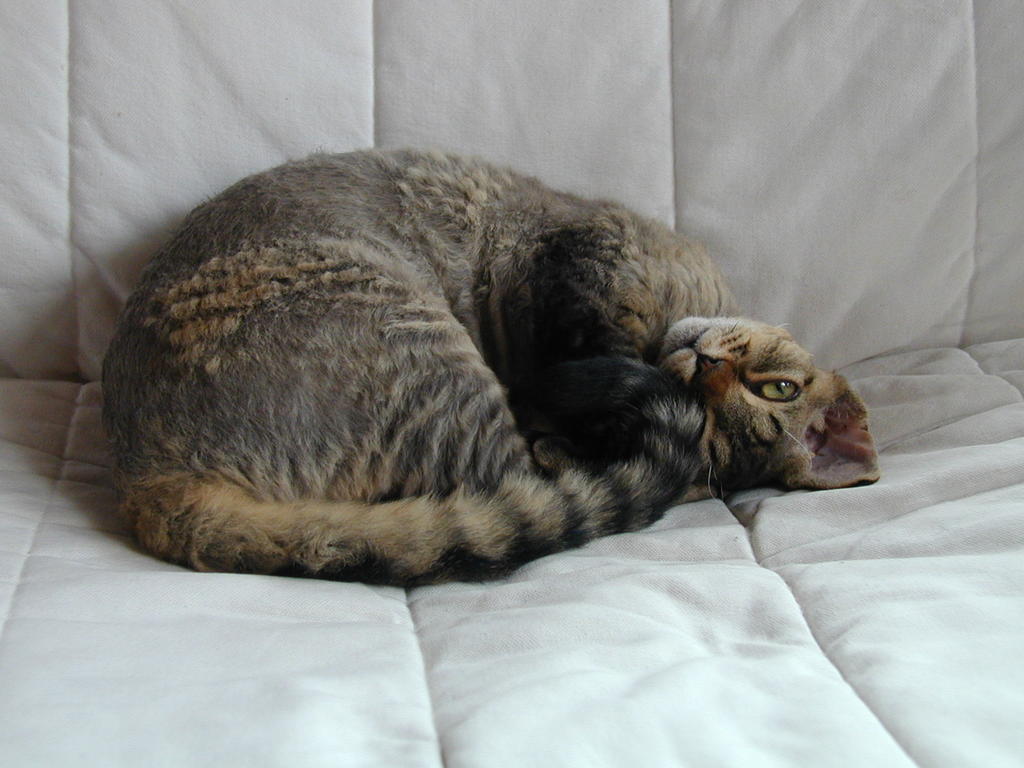
As far as differences go, Rex and Pearl certainly have distinct personalities. Pearl is perfect, or as I am tempted to say these days, purrfect. She is confident and calm and outgoing and playful. She rationally accepts new things and change and is not pushy or demanding. And then there is Rex. Rex is a little wackier. He is more energetic, more influenced by change and what is going on around him and he is a little needier and wants more attention. It’s funny because even though in my eyes Pearl is perfect, Rex is more endearing. Pearl being the more self contained one, I interact with her less. It is definitely good that they have each other. And I have to say that I feel ever so much more confident and competent raising them and setting limits now than I did (or do) with the children. It seems such a breeze in comparison and not only because they sleep 16 hours a day.
They actually seem to acknowledge and appreciate me, which rarely seems to be the case with the other dependants around here. (I’ll have to teach the kids about that drip, drip, drip of praise and affection!) I sat down yesterday to trim the kitten’s claws and they calmly let me do it and even purred. My kids have never let me trim their nails without a protest (or wash their face or hair—I wonder, did I raise feral children?). I have to give a lot of credit to the breeder who did an excellent, loving job of socializing them, but she told me no cat was going to love getting their nails trimmed, you just had to do it and let them know you were it charge. If that was something they disliked, I am amazed. Today I am going to try giving them a bath. Wondering how that will compare to bathing the kids. Oh yeah, and then there were the websites I just read about training your cat to use the toilet. I think I might try that next.
Your bedroom is not the proper place, although it will never refuse to sleep with you. Just remember that you will not be able to take away from your adult cat what you have allowed it to do when it was a kitten. …Its proper place is in its basket, in the room you have chosen. On the first night, above all do not give in to the temptation of going and fetching it, even if it is crying. Stay calm, this learning period generally lasts 3 or 4 days.
That is from a book about kittens given free from the pet food company. It is similar, I think, to the free babycare books given out at the hospital to new parents from baby food companies.
On discipline, it (predictably) recommends: "The kitten needs to understand as soon as possible the limits that it must not go beyond before its weapons (claws and teeth) are fully developed." (And did you know that stressed cats can bite their nails? "If your kitten is chewing the claws, it may be in a state of anxiety which could turn into depression." Biting nails must be very deeply ingrained in our animal minds.) There is little in it, however, about how to do this in a firm yet gentle and loving way (similar ommision in childrearing literature).
There is one big difference between the kitten- and childcare literature, however, and that is in acknowledging that each and every cat or kitten is different and has its own distinct personality. Somehow I missed that in the kid literature. Only a few cherished books had it. Certainly in cat books there is lots of info on the personalities of the different breeds (obvious reasons why this is not done for humans) but also the recognition that each cat’s own genetic makeup and life experiences will play out in different personalities and that differences can be as great within the breeds as between them. (Dog breeds in general being more diverse and distinct than cat breeds.) It is just accepted that some cats will be shy or reticent and some cats will be more outgoing or social, some quieter and some more vocal, etc. We don’t seem to have a similar acceptance or respect for differences with children.
I got this book called The Kitten Whisperer by Claire Bessant, the same woman who wrote What Cats Want. It's kind of a cats-eye view of the world, how they evolved in the wild and how they evolved to be pets. I never bought The Baby Whisperer and have only heard horror stories about it. But somehow the idea of getting advice from someone who has an expert knowledge seems okay with cats. I do want to know what cats want, them being a different species and all. (Somehow I can’t imagine a book called What Babies Want. That would be nice to see, though!) It seems good to understand their behavior from an evolutionary perspective and to see how and why these little carnivores have adapted as pets. (One of my favorite childrearing books, called Our Babies, Ourselves, was written from such an evolutionary perspective, but that is not the norm for childrearing literature.) I liked the section in The Kitten Whisperer about how cats train us. I thought it true also for childrearing, just that a childrearing book would never be so permissive of the child and acknowledge that an adult being manipulated is okay! We allow it and smile at it in other species, but not our own:
How Do Cats Train Us?
Your kitten is a very bright little character. It is on a steep learning curve and is making new discoveries every day. It learns by watching, by trial and error, and by the reactions you give it to things that it does. It learns which of its actions result in something it likes and which don't. In particular, it learns how to make you do what it wants (just like any child worth its salt!). It is up to you to decide when you are to be manipulated, when you want to be manipulated because it is actually what you want as well, and when you definitely do not want to give in!
The above paragraph, or something like it, with maybe a different spin on the manipulation part, could easily be found in a childrearing book, but the one below wouldn’t, I don’t think:
Cats are amazing teachers—most of us know we are the slaves of a cat rather than the owners.…Cats can do this because their affection rewards us—they do not have to offer food, just a meow or a purr of praise and we are putty in their hands. They seldom revert to aggression but rather give us a slow drip, drip, drip of reward for our attention—that's the way to do it!
It is nice to see the fun part, even if it is pure manipulation, acknowledged!
As far as differences go, Rex and Pearl certainly have distinct personalities. Pearl is perfect, or as I am tempted to say these days, purrfect. She is confident and calm and outgoing and playful. She rationally accepts new things and change and is not pushy or demanding. And then there is Rex. Rex is a little wackier. He is more energetic, more influenced by change and what is going on around him and he is a little needier and wants more attention. It’s funny because even though in my eyes Pearl is perfect, Rex is more endearing. Pearl being the more self contained one, I interact with her less. It is definitely good that they have each other. And I have to say that I feel ever so much more confident and competent raising them and setting limits now than I did (or do) with the children. It seems such a breeze in comparison and not only because they sleep 16 hours a day.
They actually seem to acknowledge and appreciate me, which rarely seems to be the case with the other dependants around here. (I’ll have to teach the kids about that drip, drip, drip of praise and affection!) I sat down yesterday to trim the kitten’s claws and they calmly let me do it and even purred. My kids have never let me trim their nails without a protest (or wash their face or hair—I wonder, did I raise feral children?). I have to give a lot of credit to the breeder who did an excellent, loving job of socializing them, but she told me no cat was going to love getting their nails trimmed, you just had to do it and let them know you were it charge. If that was something they disliked, I am amazed. Today I am going to try giving them a bath. Wondering how that will compare to bathing the kids. Oh yeah, and then there were the websites I just read about training your cat to use the toilet. I think I might try that next.
Subscribe to:
Posts (Atom)